The Hidden Cost of Missed Referrals in Canadian Healthcare
40% of faxed referrals never become appointments. For a mid-size Ontario clinic, that's thousands in lost billings and patients who fall through the cracks. We break down where referrals get lost and how automated intake changes the math.

BookHealth Team

Share
Here's a number that should bother every clinic owner in Canada: 40% of faxed referrals never become appointments.
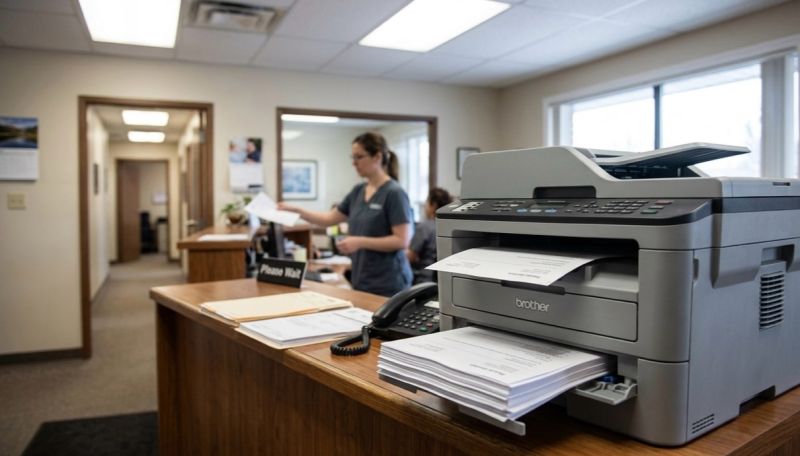
That's not a system failure at the hospital level. It's not a policy problem. It's an operational one — and it happens inside the four walls of the clinic, between the moment a referral arrives and the moment someone picks up the phone to book the patient.
For a mid-size Ontario family practice handling 30 to 50 outbound referrals per month, losing 40% means 12 to 20 patients every month who were referred to a specialist and never got there. Some of those patients will call back eventually. Some will go to a walk-in clinic. And some will simply fall through the cracks, their condition worsening while a faxed piece of paper sits in a queue that nobody has time to process.
This isn't hypothetical. It's happening right now in clinics across Canada, and the cost — both human and financial — is far higher than most practice owners realize.
Where Referrals Get Lost
To understand the problem, you need to trace the lifecycle of a referral from the moment it's created to the moment it either becomes an appointment or doesn't.
Step 1: The referral is created. A family physician sees a patient, determines they need specialist care, and creates a referral. In most Canadian clinics, this means filling out a form — sometimes digitally within the EMR, sometimes on paper — and sending it by fax to the specialist's office.
Step 2: The referral is sent. The MOA or clinic staff sends the fax. In some clinics, this happens immediately. In others, faxes are batched and sent at the end of the day. At this point, the referring clinic often has no visibility into whether the fax was received, read, or acted upon.
Step 3: The specialist receives the referral. On the receiving end, the referral arrives in a fax queue alongside dozens of other documents. The specialist's staff must sort it, confirm the patient's information, check coverage, and determine whether the referral is complete — meaning it has all the clinical information, test results, and documentation the specialist needs to assess the case.
Step 4: Missing information. This is where the process most commonly breaks down. If the referral is incomplete — missing a recent lab result, an imaging report, or specific clinical details — the specialist's office faxes back a request for more information. That request arrives in the referring clinic's own fax queue, where it competes for attention with everything else. Days pass. Sometimes weeks.
Step 5: Patient outreach. Even when the referral is complete and the specialist is ready to see the patient, someone still needs to contact the patient to book the appointment. If the specialist's office calls and the patient doesn't answer, the referral goes to the bottom of the pile. If the referring clinic is supposed to follow up, they may not know the referral was accepted in the first place.
At every step, the referral can stall, get lost, or simply age out. And in most clinics, there's no system tracking where each referral stands. It's a black hole.
The Financial Impact
Let's put numbers to it.
An Ontario family physician billing under OHIP generates revenue through patient encounters. Every referral that doesn't convert to a specialist appointment represents a gap in the care pathway — but it also represents downstream billing that doesn't happen. Follow-up visits, diagnostic work, treatment plans, and ongoing management all flow from that initial specialist consultation.
For the specialist receiving referrals, the math is even more direct. Every lost referral is a lost patient visit. At an average specialist consultation billing of $150 to $300 under OHIP, a practice losing 15 referrals per month is leaving $2,250 to $4,500 on the table — every month.
Across a year, that's $27,000 to $54,000 in lost revenue for a single specialist practice. For a multi-physician group, multiply accordingly.
And that doesn't account for the labour cost of the staff time spent on partial processing — reading the referral, starting the intake, requesting missing information, and then having the whole thing stall. That's paid labour producing no outcome.
The Patient Cost
The financial argument is easy to make, but the human cost is the one that matters most.
When a referral to a cardiologist doesn't convert, a patient with chest pain waits longer to be assessed. When an endocrinology referral gets lost, a diabetic patient's care plan is delayed. When a mental health referral ages out in a fax queue, someone who asked for help doesn't get it.
Canada's specialist wait times are already among the longest in the developed world. The Fraser Institute reports a median wait of over 27 weeks from GP referral to specialist treatment. That's the wait time for patients who successfully get through the system. The ones whose referrals never convert don't even make it into the statistics.
This is the hidden cost. It doesn't show up in any report or dashboard because the patients who fall through aren't being tracked. They're invisible.
What Automated Referral Intake Looks Like
Solving this problem doesn't require a new referral platform that every specialist and GP in the province needs to adopt. That approach has been tried, and adoption remains uneven. The solution needs to work with the infrastructure that already exists — fax machines, EMRs, and the staff who use them.
Automated referral intake works by applying AI at the point where the referral enters the clinic. When a fax arrives, the system reads the document, identifies it as a referral, extracts the patient demographics, referring physician, clinical details, and insurance information, and creates a structured record in the EMR.
If the referral is complete, the system immediately triggers patient outreach — a text message, an email, or a phone call to book the appointment. No manual data entry. No waiting for someone to get to the bottom of the fax pile.
If the referral is incomplete, the system flags exactly what's missing and automatically sends a request back to the referring provider. Instead of days or weeks, the turnaround on missing information drops to hours.
The result: referrals that used to take days to process are handled in minutes. Patients are contacted the same day their referral arrives, not the same week. And the clinic has full visibility into every referral in the pipeline — where it stands, what's missing, and how long it's been waiting.
Tracking What Was Previously Invisible
Beyond the immediate processing, automated referral management gives clinics something they've never had: data.
How many referrals are you receiving per week? What percentage are complete on arrival? Which referring providers consistently send incomplete referrals? What's your average time from referral receipt to patient contact? What's your conversion rate?
Most clinics can't answer any of these questions today because the data doesn't exist in a structured form. It's scattered across fax logs, EMR notes, and the institutional memory of whoever happened to process the document.
When you can measure it, you can improve it. Clinics using automated referral tracking are seeing conversion rates increase by 5 to 7 percentage points, processing times drop from days to minutes, and — most importantly — zero referrals lost to the black hole.
What We're Building at BookHealth
At BookHealth, referral automation is one of our core workflows. Our AI agent Natalie ingests incoming referrals from any source — fax, email, portal — extracts structured data using vision-language models, validates completeness, and syncs directly into your EMR. Our agent Barry then handles outbound patient engagement, contacting patients by SMS or phone to book appointments and confirm details.
Every referral is tracked from arrival to appointment. Nothing gets lost. Nothing ages out in a queue.
If you're a clinic owner who suspects referrals are falling through the cracks but can't prove it — that uncertainty is itself the problem. The first step is making the invisible visible.