Why Canadian Clinics Are Still Drowning in Faxes - And What AI Can Do About It
Ontario providers send over 152 million faxes per year. Most arrive as unstructured PDFs that staff must manually sort, read, classify, and enter into the EMR. Here's how AI document processing is changing that workflow.

BookHealth Team
Share
Ontario providers send over 152 million faxes per year. If that number sounds like it belongs in 1995, you're not wrong. But in Canadian healthcare, the fax machine isn't a legacy artifact — it's still the backbone of clinical communication.
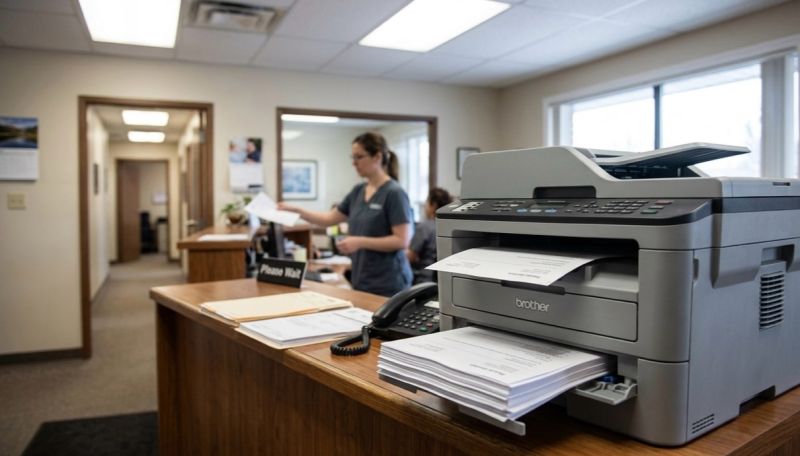
Referrals come in by fax. Lab results come in by fax. Prior authorization responses, specialist consult notes, pharmacy renewals, insurance documents, and patient records — all faxed. Every single day, medical office administrators across Canada sit down in front of a queue of incoming documents and begin the slow, manual work of reading, sorting, classifying, and entering data into an EMR that was never designed to talk to a fax machine.
This is the reality of the Canadian healthcare front office in 2026. And it's where the biggest operational bottleneck lives.
The Anatomy of a Fax Workflow
Let's walk through what actually happens when a fax arrives at a typical Ontario family medicine clinic.
A referral comes in from a cardiologist's office. It's a scanned PDF — sometimes clear, sometimes not. The MOA opens it, reads through the document to determine what it is, identifies the patient, and checks whether they're in the system. Then they classify the document type, extract the relevant clinical details, and manually enter that data into the EMR. If information is missing — and it often is — they call or fax back to request it.
This single referral might take five to fifteen minutes of focused attention. Now multiply that by the dozens of faxes arriving every day. A mid-size clinic with three or four physicians can receive over 200 inbound faxes per week. The math doesn't work. Staff fall behind, documents pile up, and patients wait.
Why Canada Still Runs on Fax
The natural question is: why hasn't this been solved already? The answer has several layers.
First, fax is deeply embedded in the regulatory and operational fabric of Canadian healthcare. Many provincial systems, hospital networks, and specialist offices are set up to communicate via fax because it was, for decades, considered the most secure and universally accessible method of transmitting health information. Changing that requires coordination across thousands of independent organizations — and that kind of coordination doesn't happen quickly.
Second, the Canadian EMR landscape is fragmented. Unlike the United States, where Epic and a handful of large platforms dominate, Canadian clinics run on Accuro, OSCAR Pro, Telus PS Suite, and a range of other systems that don't always talk to each other. Interoperability is improving — projects like Ontario's AMPLIFI initiative are connecting hospital systems to long-term care homes through PointClickCare — but the ground truth in most clinics is still disconnected.
Third, and perhaps most importantly, the alternatives haven't been good enough. eReferral platforms exist, but adoption is uneven. Many specialists still prefer fax because it's what they know and it works with their existing setup. The system won't change overnight, which means any solution needs to work with fax as it exists today, not as we wish it were.
What AI Document Processing Actually Looks Like
This is where AI-powered document automation enters the picture — and it's worth being specific about what that actually means, because the term "AI" gets applied to a lot of things that don't deserve it.
Modern document processing for healthcare uses a combination of optical character recognition (OCR) and large language models (LLMs) to read, understand, and act on incoming documents. The process works in stages.
When a fax arrives, the system first converts the scanned image into readable text. This is the OCR step, and it's been around for years — but the accuracy has improved dramatically with the latest generation of vision-language models that can handle handwritten notes, checkboxes, poor scan quality, and multi-page documents.
Next, a language model classifies the document. Is it a referral? A lab result? A prior authorization response? A pharmacy renewal request? A records request? Each of these has a different workflow, and the AI needs to route it correctly.
Then comes extraction. The model pulls out the relevant structured data: patient name, date of birth, referring physician, diagnosis, requested procedure, medications, insurance information. This is where healthcare-specific training matters — a general-purpose AI might misread clinical terminology or miss the significance of a particular field. Models trained on healthcare documents understand the context.
Finally, the extracted data is synced into the EMR, creating or updating the appropriate patient record and triggering the next step in the workflow — whether that's notifying the physician, scheduling an appointment, or flagging missing information for follow-up.
The entire process, which might take a human ten to fifteen minutes per document, can be completed in under two minutes with AI handling the processing and a human reviewing the output for accuracy.
Why Canadian Clinics Stand to Gain the Most
Most of the investment in AI-powered healthcare automation has focused on the US market. Hundreds of millions of dollars have been deployed south of the border into tools that automate scheduling, referrals, and patient access — but virtually none of those solutions work in Canada. They don't integrate with Canadian EMRs, they don't comply with Canadian privacy law, and they don't support the workflows that Ontario and BC clinics rely on.
That gap is the opportunity. Canadian clinics operate on tighter margins than their US counterparts. They can't easily hire additional staff to manage growing fax volumes. OHIP billing rates don't increase at the pace of operational costs. And the regulatory environment — PHIPA in Ontario, PIPEDA federally — creates compliance requirements that make manual document handling not just inefficient but risky.
A clinic that automates its fax processing doesn't just save time. It reduces the risk of misfiled documents, accelerates referral turnaround, improves patient access to care, and frees up its most valuable resource — trained clinical staff — to focus on patients rather than paperwork.
The technology is ready. The regulatory environment is supportive, with Ontario's government actively investing in digital health infrastructure and quality reporting. The workforce crisis — with nursing vacancies across the country and MOA turnover increasing — makes automation not a luxury but a necessity.
What We're Building at BookHealth
At BookHealth, our AI agent Natalie is purpose-built for this exact workflow. She processes incoming faxes, classifies documents, extracts structured data, and syncs it into Canadian EMRs — Accuro, OSCAR Pro, Telus PS Suite, and PointClickCare. Every document goes through a human-in-the-loop review step before it's committed to the patient record, because in healthcare, accuracy isn't optional.
We're not trying to eliminate the fax machine. We're trying to eliminate the hours your team spends reading what comes out of it.
If your clinic is spending more time processing paperwork than caring for patients, that's the problem we exist to solve.