What We Mean by "AI Front Office" - And What We Don't
"AI" gets thrown around a lot in healthtech. At BookHealth, our AI agents — Natalie, Barry, and Rachel — each handle specific front office workflows with human oversight built in. Here's exactly what they do and where humans stay in the loop.

BookHealth Team

Share
"AI" is the most overused word in healthtech right now. Every software vendor has added it to their pitch deck. Every EMR company claims to be "AI-powered." And every week, a new startup announces they're using artificial intelligence to transform healthcare.
Most of the time, it's marketing. A rules engine with a chatbot on top. A template system that auto-fills forms. An analytics dashboard that someone decided to rebrand as "intelligent."
We're not interested in that game. At BookHealth, when we say we're building the AI front office for Canadian healthcare, we mean something specific. This post is about what that means in practice — what our AI agents actually do, where they work autonomously, and where humans stay in the loop.
The Three Agents
BookHealth's platform is built around three AI agents, each with a distinct role in the front office workflow. We named them because we think of them as members of the team — not replacements for the team, but additions to it.
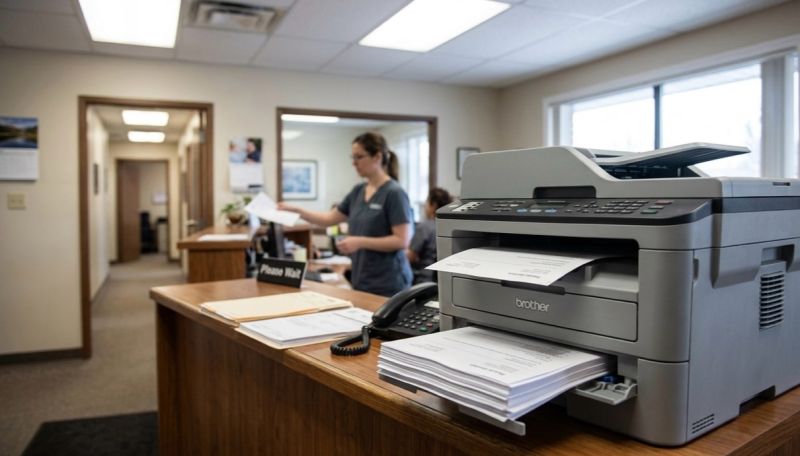
Natalie handles everything that arrives at the clinic: incoming faxes, referrals, lab results, insurance documents, pharmacy renewal requests, and patient records. She reads, classifies, extracts, and routes. If a faxed referral arrives at 7 AM, Natalie has it classified, the patient data extracted, and the record updated in the EMR before the first staff member sits down with their coffee.
Barry handles everything that goes out: patient outreach, appointment confirmations, follow-up reminders, recall campaigns, and prescription renewal notifications. When Natalie processes an incoming referral, Barry picks up the next step — reaching out to the patient by SMS or phone to get the appointment booked. When a shift needs filling, Barry contacts available staff in priority order. When a family member needs an update, Barry sends it in their preferred language.
Rachel handles everything that comes in by phone. She's our AI voice receptionist — answering inbound calls, understanding what the caller needs, and either resolving it directly or routing it to the right person. Patient calling to book an appointment? Rachel handles it. Family member asking about visiting hours? Rachel answers. Staff member calling in sick at 5:30 AM? Rachel logs the absence and triggers Barry to start filling the shift.
Together, they cover the three primary channels of front office work: documents, outreach, and voice.
What "AI-Powered" Actually Means Here
Let's get specific about the technology, because this matters.
Natalie's document processing pipeline uses a combination of optical character recognition and vision-language models. These are AI models specifically designed to look at images of documents — including scanned faxes, handwritten notes, and forms with checkboxes — and extract structured information from them. This isn't keyword matching or template recognition. The models understand clinical context: they know the difference between a referral and a lab result, they can identify patient demographics in different document layouts, and they can flag when critical information is missing.
Rachel's voice engine uses real-time speech-to-text, natural language understanding, and text-to-speech. When a patient calls, Rachel doesn't play a phone tree. She listens, understands the intent, and responds conversationally. The voice model is trained on healthcare-specific call patterns — appointment scheduling, prescription inquiries, general questions, and urgent routing. She supports English and French natively, with Tamil, Mandarin, Cantonese, and Punjabi in development.
Barry's outreach engine orchestrates multi-channel communication — SMS, phone, and email — with sequencing logic that adapts based on patient response. If a patient doesn't respond to a text message within four hours, Barry follows up with a phone call. If a staff member accepts a shift via SMS reply, Barry confirms the booking and updates the schedule automatically.
All three agents write back to the EMR in real time. They don't create separate systems or extra dashboards that staff need to check. The information shows up where staff already work — inside Accuro, OSCAR Pro, Telus PS Suite, or PointClickCare.
Where Humans Stay in the Loop
This is the part that matters most, and the part that most AI companies underplay.
We believe in a simple principle: AI should process, humans should approve. Every workflow in BookHealth includes a human verification step for decisions that affect patient care.
When Natalie classifies a document and extracts data, the output goes into a review queue. A staff member — an MOA, a nurse, or the physician themselves — reviews the extracted information before it's committed to the patient record. The AI does the heavy lifting of reading and structuring; the human confirms it's correct.
This is especially critical for high-stakes workflows. When a physician's dietary order arrives for a patient in a care facility, the AI extracts the order details and checks them against the patient's allergen profile. If there's a conflict — say, a meal containing peanuts assigned to a patient with a documented peanut allergy — the system blocks the order and escalates it to a nurse or dietary manager for review. The AI doesn't override clinical judgment. It surfaces the information faster and catches conflicts that a busy human might miss.
For voice calls, Rachel resolves routine inquiries autonomously — office hours, directions, appointment availability — but transfers complex or sensitive calls to a human. A patient calling about a clinical concern gets routed to the nursing station. A family member with a complaint gets connected to the administrator. Rachel doesn't try to be a clinician. She tries to be the best receptionist your clinic has ever had.
We track a metric we call the "escalation rate" — the percentage of interactions that Rachel can't resolve on her own and hands off to a human. Our target is under 15%. That means 85% or more of routine inbound calls are handled without human intervention. The remaining 15% are the calls that should go to a person — and they get there faster because Rachel has already handled the queue.
What We Don't Do
Clarity about what we don't do is just as important as what we do.
We don't do clinical decision support. BookHealth doesn't diagnose, recommend treatments, or make clinical judgments. We automate administrative workflows — the operational layer that sits between the patient and the care they need. We move paper, schedule appointments, fill shifts, and answer phones. The clinical decisions stay with the clinicians.
We don't replace staff. We automate the tasks that staff shouldn't be spending their time on. Reading faxes, making phone calls to fill shifts, sending appointment reminders, entering data into the EMR — these are tasks that consume hours of trained professionals' time every day. When AI handles them, staff can focus on the work that actually requires their expertise and judgment.
We don't require you to change your tools. BookHealth connects to the EMR systems you already use. We don't ask you to adopt a new platform, learn new software, or change your existing workflows. Our agents work inside your systems, following your rules. If your clinic has specific scheduling logic — certain providers only see certain appointment types on certain days — our system encodes those rules and follows them exactly.
We don't store data outside Canada. All patient health information is processed and stored within Canadian data centres. We comply with PHIPA and PIPEDA from the ground up, not as an afterthought. Canadian data residency isn't a feature we market. It's a requirement we meet.
Why We Named Them
A quick note on why we gave our AI agents names. It's a deliberate choice.
When a clinic administrator says "Natalie processed 200 faxes today" or "Rachel handled 50 calls this morning," it creates a shared language for talking about what the AI is doing. It makes the technology approachable rather than abstract. And it reinforces the mental model we want: these are team members with specific roles, not a monolithic "AI system" that does vaguely everything.
Natalie handles the inbox. Barry handles outreach. Rachel handles the phone. If you remember nothing else about BookHealth, remember that.
The Bigger Picture
We're building BookHealth at a specific moment in Canadian healthcare. The workforce crisis is real — nursing vacancies are at record levels, clinic staff are burning out, and the administrative burden on healthcare workers has grown exponentially over the past fifty years. The technology to automate front office work is finally mature enough to trust with real clinical workflows. And the regulatory environment in Canada is actively encouraging digital health adoption.
The AI front office isn't a concept. It's software that exists, works, and is being used by Canadian clinics today. It processes faxes, tracks referrals, fills schedules, answers phones, and connects to the EMR systems that power Canadian healthcare.
That's what we mean by "AI front office." Nothing more, nothing less.