Why Voice AI Is the Next Frontier for Canadian Clinics
42% of patient calls go unanswered during peak hours. Voice AI doesn't replace your receptionist — it makes sure the front door of your clinic is never closed. Here's what it looks like in practice.

BookHealth Team

Share
Every clinic has the same story about the phones.
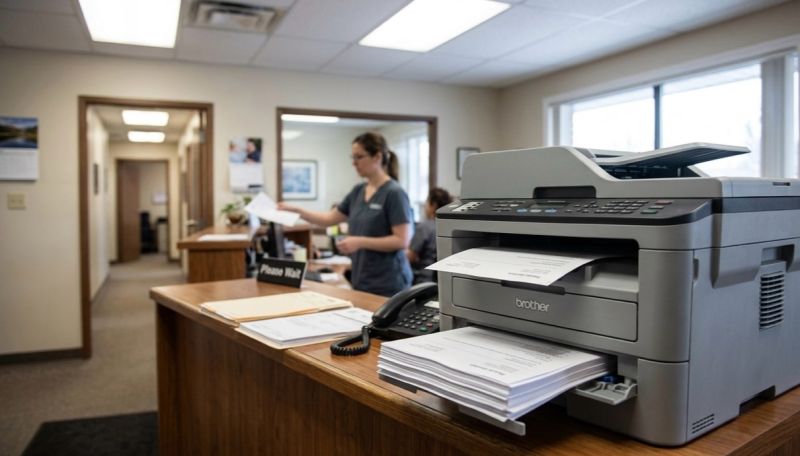
The morning rush starts around 8:30 AM. Patients call to book appointments, confirm prescriptions, ask about lab results, check wait times, and request referral updates. The MOA answers as fast as they can, but the calls stack up. By 9:15, there's a queue. By 9:45, patients are on hold for five, ten, sometimes fifteen minutes. Some hang up and try again later. Some don't call back at all.
During peak hours, 42% of patient calls to Canadian clinics go unanswered. That's not an estimate from a survey — it's a data point that should alarm every clinic owner in the country. Nearly half of the people trying to reach their healthcare provider can't get through.
The phone is the front door of every clinic. And for most of the day, that front door is closed.
The Phone Problem Is a Staffing Problem
It's tempting to frame this as a technology issue, but it's fundamentally a staffing one. Most clinics have one or two MOAs handling the phones alongside a dozen other responsibilities — checking patients in, processing faxes, entering data into the EMR, managing the schedule, handling walk-ins, and coordinating with the physicians. The phone is one task among many, and it's the one that gets deprioritized when everything else is urgent.
Hiring more phone staff isn't a realistic solution for most Canadian clinics. OHIP billing rates don't grow at the pace of labour costs. A full-time receptionist costs $40,000 to $55,000 per year in Ontario, plus benefits. For a family practice billing $500,000 to $800,000 annually, that's a significant overhead increase to solve a problem that only peaks for a few hours each day.
The result is a structural mismatch: clinics need phone coverage that scales up and down with demand, but they can only afford staffing that's fixed.
What Voice AI Actually Does
Voice AI for healthcare isn't a phone tree. It's not "press 1 for appointments, press 2 for prescription refills." That model has been around for decades and patients hate it — because it doesn't actually resolve anything. It just sorts you into a queue where you wait for a human.
Modern voice AI answers the phone like a person. It listens to what the caller says, understands the intent, and either resolves the request or routes it appropriately. The technology behind this has improved dramatically in the past two years. Real-time speech-to-text models transcribe the caller's words with high accuracy. Natural language understanding models interpret what the caller needs. And text-to-speech models respond in a natural, conversational voice — not a robotic monotone.
At BookHealth, our voice AI agent Rachel handles the most common inbound call types for Canadian clinics:
Appointment scheduling. A patient calls to book a follow-up. Rachel checks the provider's availability in the EMR, confirms the appointment type, and books it — all in a single conversation. No hold time. No callback needed.
Prescription renewal inquiries. A patient calls to check if their prescription renewal has been processed. Rachel looks up the status and provides an update. If the renewal requires physician review, Rachel lets the patient know and provides a timeline.
General inquiries. Office hours, clinic address, parking information, which insurance plans are accepted, what to bring for a first visit. These questions don't require clinical judgment — they require information that Rachel can provide instantly.
Call routing. When a call requires a human — a clinical question, a complaint, an urgent matter — Rachel transfers the caller to the right person with context. The physician's office gets a summary of what the patient needs, so they're not starting from scratch.
After-hours coverage. Rachel answers at 2 AM the same way she answers at 2 PM. Patients who need to book an appointment on a Sunday evening can do it. Clinics that currently lose after-hours calls to voicemail — and the patients who never leave a message — now capture that demand.
The Metrics That Matter
Voice AI for healthcare has already been validated at scale in the United States. Published results from US deployments show hold times dropping from eleven minutes to one minute, call abandonment rates falling from 41% to 8%, and patient satisfaction scores for AI-handled calls averaging 4.6 out of 5 — higher than the human average of 3.9.
These numbers are striking, but they come from a US context with different healthcare economics. The Canadian opportunity is different, and in some ways more compelling.
Canadian clinics don't have the luxury of large call centre teams. They can't throw headcount at the problem. Every minute an MOA spends on the phone is a minute they're not processing faxes, managing the schedule, or handling patient check-ins. Voice AI doesn't replace the MOA — it handles the portion of their workload that's most repetitive and most interruptible, giving them back hours in the day.
The metrics we track for Rachel are simple. Average call resolution time — how quickly the patient's need is addressed. Escalation rate — what percentage of calls require a human transfer. Patient satisfaction — measured through post-call surveys. And call volume handled — how many inbound calls Rachel resolves per day without human intervention.
Our targets: under two minutes average resolution time, under 15% escalation rate, and above 4.5 out of 5 patient satisfaction. These aren't aspirational numbers. They're the benchmarks that voice AI has already achieved in US healthcare, applied to the Canadian clinic environment.
Multilingual by Default
Here's where the Canadian context creates a genuine differentiation from anything available in the US market.
The Greater Toronto Area is one of the most linguistically diverse metropolitan areas in the world. Over 200 languages are spoken across the region. In many Ontario clinics — particularly in Scarborough, Markham, Brampton, and Mississauga — a significant portion of patients and their families communicate primarily in Tamil, Mandarin, Cantonese, Punjabi, or French.
Most US voice AI solutions support English and Spanish. Some support a dozen or more languages at a basic level. But none are optimized for the specific linguistic communities that Canadian clinics serve.
Rachel is being built with multilingual support as a core requirement, not an add-on. English and French are our launch languages — French being an obvious necessity for clinics serving francophone populations and for compliance in bilingual settings. Tamil, Mandarin, Cantonese, and Punjabi are in active development.
For a clinic in Scarborough where half the patients' families speak Tamil, or a Markham practice where Mandarin and Cantonese are common, this isn't a nice-to-have. It's the difference between a voice AI that actually works for their patient population and one that doesn't.
The Trust Question
The most common objection we hear from clinic owners about voice AI is simple: will patients accept it?
The evidence from the US market suggests yes — and more quickly than most people expect. Data from large-scale US deployments shows that patient satisfaction with AI voice agents actually exceeds satisfaction with human operators. This makes sense when you consider the alternative: patients would rather get their appointment booked in ninety seconds by an AI than wait eleven minutes on hold for a human.
The key is transparency. Rachel introduces herself as an AI assistant at the beginning of every call. Patients always have the option to request a human. And every call that involves a clinical question, a sensitive situation, or anything outside Rachel's defined scope is immediately transferred.
Trust isn't built by pretending the AI is human. It's built by the AI being faster, more accurate, and more available than the alternative — and honest about what it is.
What This Means for Your Clinic
If you run a Canadian clinic and your phones are overwhelmed during peak hours, if your MOAs are spending half their day on calls that don't require clinical judgment, if you're losing patients who hang up and don't call back — voice AI isn't a futuristic concept. It's available now.
The front door of your clinic should never be closed. Rachel makes sure it isn't.